- Stability: Inductance change is less than 0.01% per year.
- Temperature Coefficient of Inductance: Approximately 30 ppm/°C.
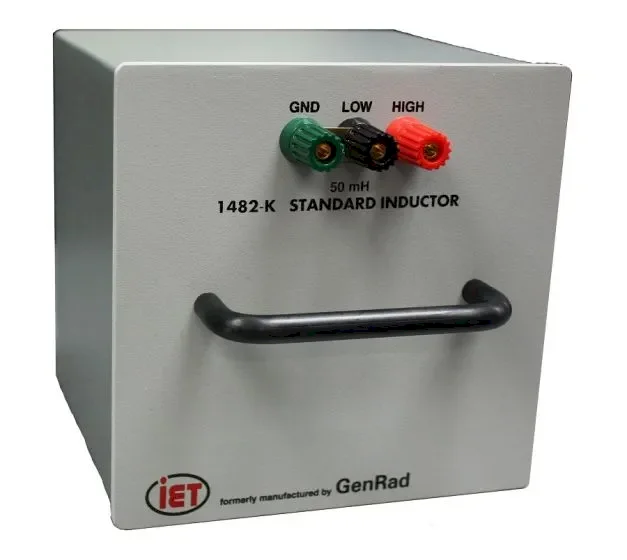
- Terminals: 5-way gold-plated, tellurium-copper binding posts that feature low resistance. Terminals have standard ¾-in spacing with removable gold-plated ground strap.
- Dimensions: 16.6 cm H x 16.6 cm W x 20.4 cm D (6.5" H x 6.5" W x 8" D)
- Weight: 5.3 kg (11.5 lb) net, 6 kg (13 lb) shipping
1482 Induktance standard1482
GenRad 1482 Standard Inductors
Why choose the 1482?
For more than 60 years, the 1482 has been a benchmark for inductance measurement. National metrology institutes and leading calibration laboratories around the world rely on it (see the CCEM WGKC/2001-15 comparison). Its inductance remains stable over time and does not depend on the applied voltage or current. Many technical papers describe its characteristics.
Overview
The GenRad 1482 is the standard of choice in metrology labs. IET Labs continues to build it to the same exacting specifications as General Radio. It serves as an accurate, highly stable standard of self inductance, used as a low-frequency reference or a working standard.
A brief history
GenRad introduced the 1482 series in 1952 to replace the earlier 106 series. The new design offered a better temperature coefficient and was far less sensitive to the electrical environment and ambient humidity. GenRad also made the 1481 series of fixed toroidal inductors. These are smaller because they use a ferromagnetic core, but their inductance changes with the current flowing through them.
The challenge of the ideal inductor
Of the three basic components (R, L, C), the inductor is the furthest from ideal. An ideal inductor would have no resistance or capacitance, would be dimensionally stable, and would be unaffected by orientation, external magnetic fields, temperature or aging. In practice, a capacitor can use air as an almost perfect dielectric, whereas an inductor needs real wire with finite resistance. Designers must also deal with winding capacitance, field geometry, pickup, frequency response, magnetic saturation and temperature coefficient.
How the 1482 solves these problems
- Symmetrical toroidal winding: it offers much better astaticism than earlier inductors. GenRad built a dedicated winding machine for this, and IET Labs still maintains and uses the original three machines.
- Litz wire in duplex winding: the duplex winding on a steatite core minimizes pickup from external fields, and the inductor produces no external magnetic field.
- Steatite L-5 ceramic core: it has low thermal expansion, and its elliptical cross section avoids sharp bends in the winding.
- Aging: after winding, the cores are aged for several days to improve stability.
- Mounting and sealing: each core is potted in a box with ground cork and desiccant, so it effectively floats, and the position of the assembly in the aluminum housing is chosen to improve performance. A potting compound then seals the unit, which limits the effects of humidity.
Connections
Inductors of 500 µH or less have six gold-plated, low-thermal-emf binding posts. This lets you measure both the inductance L and the zero inductance Lo without moving the cables, which would introduce errors. A shorting link is moved between Lo and L, and the calibrated value is the difference between the two. Inductors above 500 µH have three gold-plated binding posts. To compare other inductors against these standards by the transfer method, IET recommends the 1689 or 1693 Digibridge.
Further reading
- GenRad Experimenter, November 1952 (design of the 1482)
- B-12 publication: determining the resonant frequency of the 1482
- CCEM WGKC/2001-15: international comparison of 10 mH 1482 standards at 1 kHz
- “Influence of Adaptors on the Calibration of Inductance Standards”